People of purpose

Aside from part-time jobs in a games shop and an apple orchard, I’ve always worked in public and community sectors – so in terms of business savvy, I’m what you might call a babe-in-the-woods. In fact, I have a fairly strong aversion to capitalism because by definition it promotes exploitation (of the earth’s resources and people) and injustice.

However… it’s the system we have, and I am in it, so if I want to make a positive contribution to the world I can’t just hang round on the edges. I must endeavour to use the system against itself. Yeah, it would have been better to have recognised that decades ago.

Ever since I adopted a mission to empower people to sense the connection, I’ve struggled with the business side of the venture – logistically but also… philosophically. (Total woods-babe, see?) So when I heard about the inaugural Purpose do, I was keen to go to see if I couldn’t imbibe a business brain – and philosophical appeasement, to boot – from a crowd of care-ful capitalists.

Seven young women on a stage before a crowd of people. The screen says 'Purpose / #purpose2015' and the staging includes mountains, waves and clouds.

The Purpose crew – the army of volunteers being offstage at this time

And it was good! I have a pathologically low stamina for large-scale events but I felt fine almost all the way through this one. (It wasn’t until I was about to leave the after-party that I lost the power of coherent speech.) I’m not sure what made this conference so easy for me to appreciate. It may have been Wildwon‘s superb, detailed planning (beyond the great program):

  • actually beautiful nametags
  • charming and always accessible volunteer staff
  • music to accompany each new speaker’s approach to the stage
  • perpetual coffee (thanks to this right-on bank) in a reusable gift cup-to-keep)
  • frog and bird calls in the bathrooms
purpose-swag

Swag I actually wanted

Or it may have been Matt Wicking‘s creative audience manipulation:

  • a crowdsourced aural rainstorm
  • metaphorical status updates
  • a two-minute dance party

Or perhaps it was the fact that everyone there was present in part because they care about being a decent human.

As well as enjoying the experience it was a great conference for me in terms of affirming and (the best part) challenging my sense of how the world works. Here are eight lessons I shared over Twitter:

  1. Procurement contracts are a great untapped tool for social change.
  2. Crowdfunding works best where the impact of the work is direct, and its success depends on manyMANY hours of effort.
  3. People don’t want to be weighed down with reason.” They want to *feel good*.
  4. Be 100% yourself.” I think it was the sage who said that.
  5. A bonsai cutting will survive in open ground; but if you replant the whole tree it will die.
  6. In the forced stillness of prison, people learn to perceive anew – to innovate. Take that, .
  7. A gem from : radical trust yields a return that is exponential.
  8. Incentives *contaminate* intrinsic motivations.”

Yep, the speakers were consistently excellent as well. In short, the Purpose do was a beautiful and engrossing cradle for me to grow a little bit, both personally and professionally.

Museums and the playful web – a revolution in sensemaking

Below is a 15-minute slides-and-voice version of my presentation to Museums & the Web Asia in Melbourne on 6 October 2105. And here’s the original, longer paper (300kb PDF).

Production notes

Presented:
- in Keynote via Keynote remote, with its nifty drawing-on-screen 
function

Recorded:
- Quicktime (for images)
- Voice Recorder on iPhone (for audio) – and yeah, the audio is
suboptimal; I considered re-recording it so I sounded less laboured
and boomy, but decided to move on. Forgive me...

Compiled into a movie:
- Images and voice merged in iMovie

Published:
- on YouTube because you can upload notes and it automatically 
matches the words to your voice

In this new digital age, the future is analogue

How can an 80-year-old institution persistently drive cultural innovation? It’s an interesting question, and one that Glenn Lowry, longtime director of the Museum of Modern Art, addressed in his recent lecture at the National Gallery of Australia. I don’t claim to have a solution, but I do want to draw attention to what I regard as an error, or oversight, in Lowry’s (and others’!) thinking – which I believe could clarify the problem, at least for the foreseeable future.

Lowry impressed the audience – myself included – with his enthusiastic embrace of technology for maintaining MoMA’s edginess.

Glenn Lowry in front of a screen illustrating the ways in which MoMA is 'doing digital'

And he secured my full attention with this next slide, on principles for working in the context of an increasingly complex and unpredictable world.

Glenn Lowry in front of a screen displaying a set of principles for the network age

The principles are borrowed from a presentation by Joi Ito, MIT Media Lab director. They are inspired by the fact that the modern industrial way of being in the world no longer works. Now that the means of production and distribution are accessible to almost anyone, the process – of business, culture and so on – is much more complex and difficult to control. How to adapt to these new circumstances is not yet clear but we do know that our survival depends on radical adaptation.

So we’re starting to revise our mental models of how the world works. Lowry talked about this shift with reference to two diagrams of the genealogy of modern art. First, he presented this 1936 diagram of cubism and abstract art, made by MoMA’s first director, Alfred Barr:

Glenn Lowry showing a slide on cubism and abstract art

He contrasted that with a diagram produced for MoMA’s 2012 exhibition, Inventing Abstraction:

Glenn Lowry presenting a slide showing the network diagram MoMA  made for its 2012 exhibition, Inventing Abstraction

In 1936, the mental model was was a linear and hierarchical genealogy; by 2012, it had become a dynamic, interconnected network. And the network model is useful because it accommodates complexity and cultivates lateral thinking.

It’s not that networks are new – the map is not the territory, right? The same artists were the subject of both diagrams; ecosystems and social systems have always operated through complex clouds of relationships; and – this is an obvious but critical point – there have always been peoples for whom the modern western scientific industrial model of the world is foreign and highly fraught (to say the least).

So what’s going on now is not an update of our mental models to fit a new world order. Rather, we’re having to let go of aspects of our customary (modern western) thinking in order to recognise the eternal fact of our network-connected reality. In this sense what’s happening now is a reversion to a pre-industrial epistemology, to a mental model that preceded and will supersede – at least in part – logical, binary oppositional thinking.

The troubling part – and this is the point to which I objected in Lowry’s talk – is that we conflate digital technologies with network thinking, and misidentify the outmoded model as analogical.

Wrong, wrong, wrong! Computers are built on binary logic; they are the quintessentially logical outcome of reductive, logical, binary oppositional, linear, hierarchical, mechanistic, modernist thought. Yes, they have levelled up, lately, so that our interfaces to them can now show an interactive web of connections; they have become adept at mapping networks. But in this, they are serving our aspiration for technology to transcend digital, to return us to our natural analogical milieux.

The excitement of 3D printing and the thriving maker movement are testament to this yearning for a futuristic analogue, but it’s more than that. Another clue is in the fact that for Lowry and for the thousands of New Yorkers who flocked to it, a standout MoMA exhibition was Marina Abramović’s The artist is present, where every day for the duration of the exhibition, anyone could go and sit with her, in silence. Abramović’s work is about the space between herself and the visitor, the dynamic, continuous gradient, the common ground, the humanity – it is precisely, I would argue, about the analogue.

We don’t need to learn to think digitally; we need to find ways to harness digital technologies in the service of enriching our analogical (interconnected, poetic, holistic, three-dimensional) experience of the world. That’s one way to describe my mission in making this game of analogy. And it seems like an ample agenda for any modern art museum keen to stay edgy in the next century.

Prescript

Here’s how I tried to express these ideas right after the lecture, in two tweets.

My DO dialogue

Last week I drove into the gorgeous (if cold!) Victorian high country to attend the inaugural Australian Do Lectures at the very lovely Payne’s Hut.

OMG interesting people! As well as enjoying the official talks, I was plenty inspired by in-between conversations with non-speaking Do-ers. It was an intense connective experience, quite exhausting but since my homecoming I’ve been thinking about it and planning some action.

The diagram below shows some of the frequencies I tuned into while listening to the talks.

My DO dialogue

Obviously it’s ‘sembly’. By identifying themes that multiple speakers addressed, I’m taking a Sembl approach to thinking and talking about my experience of the lectures. It may be a little cryptic (? do I need to explain it further?) but I hope it conveys a substantial sense of DO goodness.

Dear Wellington, let’s make some babies

Ah, Wellington, where a barista serves coffee to a cashless newcomer with “just pay us later”, op shops have natural-fibre clothes to fit women of long length, and an annual conference exemplifies and amplifies goodness.

I was there primarily to attend the National Digital Forum 2012 and – thrill! – to present on Sembl. It was a wonderful new experience to be on stage early in a conference program – and in a plenary session – because in the breaks, conversations had already started. I didn’t need to perform repeated, monologic self-introductions – and nor did my interlocutors; there was space among the already-started conversation to explore where they were coming from too.

I can’t tell you how much I appreciated that. For me, sustaining social openness for the duration of a multi-day event – which is critical, because that interpersonal flow is the source of the magic – feels strenuous. Anything that makes the flow flow more easily is like a full lung of fresh air.

Wonderfully, NDF is in general very conducive to such flow. The organisers do a brilliant job of creating a space in which good things can happen. There’s a lovely collegial vibe, and plenty of social events for folks that don’t know folks. And if you don’t know the way to a venue, Courtney will draw you a map:
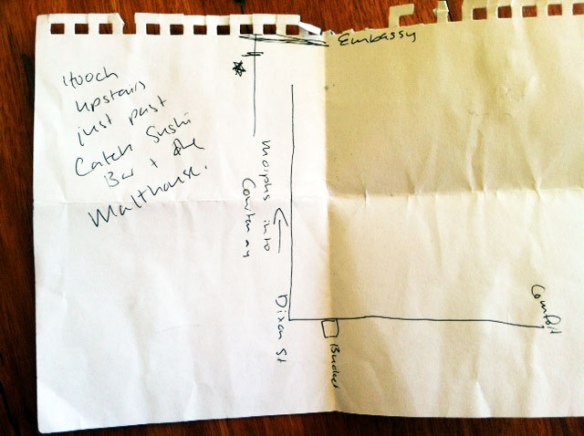
directions to Hooch bar, Wellington, New Zealand

From the Comfort Hotel via the bucket fountain to the Hooch bar

So many interesting conversations… fuelled by such passionate and thoughtful presentations:

Chris McDowall presenting on a large screen his clusters of algorithmically-cropped faces of WWI soldiers
Chris McDowall zooming in on his clusters of algorithmically-cropped faces of WWI soldiers

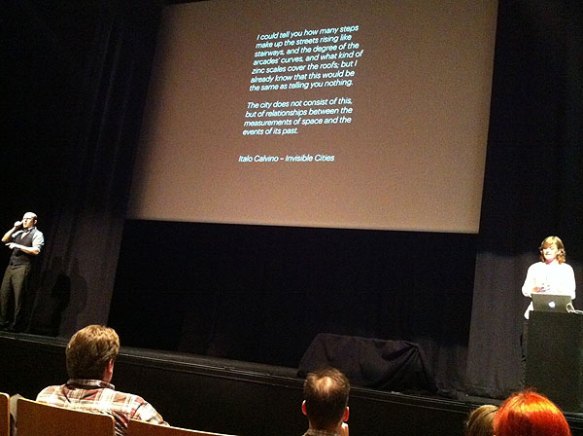
Sarah Barns presenting Italo Calvino's description of the

Sarah Barns’ augmented city projects are great. I liked her quote of Italo Calvino on the city’s “relationships between the measurements of space and the events of its past”.
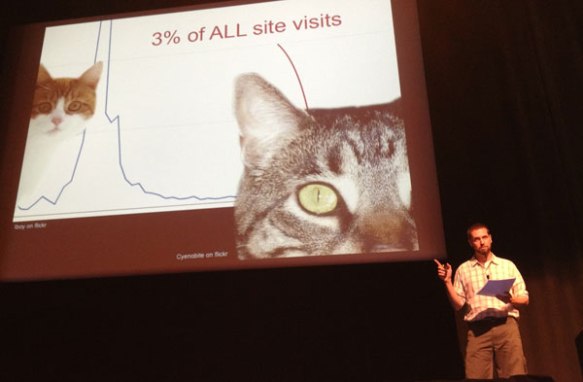
Nate Solas presenting a large-screen image of the long tail of cat videos

Nate Solas visualising the long tail of cats: the enduring value of cat videos for web visitors to the Walker Art Center

NDF was beautiful and thrilling; so much care, absolutely cynicism-free.

Despite being fairly spent, I trundled myself off the following day to join in the heady fun of THATCamp Wellington. Which was also awesome – thanks, Donelle and Sydney & co. Tim’s workshop was ‘smashing’ 😉 Also very useful was the session on linked open data; it gave me more clarity about the authority, provenance and reciprocity of said links:
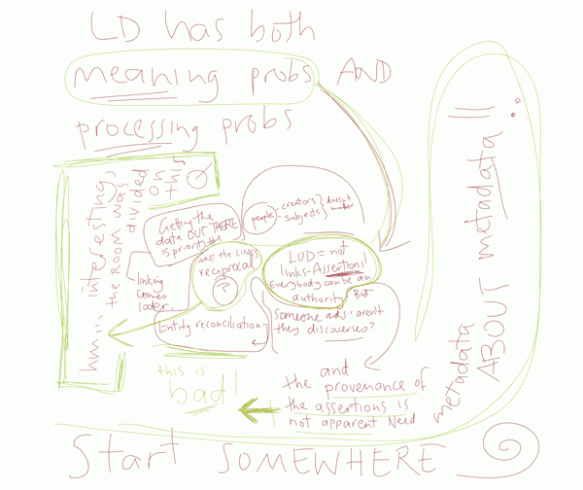
notes on the authority, provenance and reciprocity of linked data

Notes from the discussion of linked data: on authority, provenance and reciprocity

(For those that don’t know, I have a special interest in reciprocal linked data.)

In the breaks, there were plenty more compelling conversations to be enjoyed, including a very useful pointer from musicologist, Francis Yapp, to Bach’s Little Fugue in G minor. I can now appreciate the fugue musically as well as mentally!

But I failed, actually, to put as much energy into THATCamp as I’d have liked. I devoted most of my energy to NDF and then limped through the day that was meant to be all about action.

So as a homage to both NDF and THATCamp, and in lieu of completing a THATCamp evaluation form, I wrote a fantasy for a more integrated and even more flow-y NDF-meets-THATCamp experience, where more of the threads dangling tantalisingly at both forums could be tugged, if you so chose, and twisted and woven into a few amazing new things. I offer these thoughts without expectation, and with hope that whether NDF maintains its current, beautiful form or evolves, we can sustain it as it sustains us.

And dear reader, please know that I have co-opted real people into this fantasy without their knowledge or consent. They may not actually want to do these things. You are all, of course, are welcome to respond with your own ideas, adaptations, augmentations, even refutations.

§

Imagine.

The two-day National Digital Forum is extended to a three-day digital festival culminating in a THATCampy makerspace, with an optional extra post-festival morning of relaxation and celebration. NDF has some practical outcomes, and THATCamp has an inspiring lead-in and opportunity to develop some collective vision.

Day 1 is the plenary, and comprises a couple of keynotes, several short plenary presentations and a bunch of ignite talks. So there’s a whole day where everyone can see everything on offer.

Day 2 is for parallel sessions. There are two streams: one is for preplanned, interactive show-and-tell. The other is for action-planning workshops driven by the wishes of the participants and facilitated by the likes of:

  • Chris McDowall, Mitchell Whitelaw and Tim Wray – beautiful visual browsing
  • Tim Sherratt and Michael Lascarides – really simple RDF, aka beautiful data storytelling
  • Sarah Barns – augmented Te Papa?
  • Aaron Straup Cope – some strangely but simply useful tool or other
  • maybe even Walter Logeman – a Semblified, Jungian, group dream analysis

By the end of Day 2, we have some plans for action the following day.

Day 3 is a makerspace, for making as per the plans from the two days prior, and for documenting the making. Huzzah! And/or you can do one or more preplanned workshops with the likes of:

  • Ponoko
  • someone who can make artisinal QR codes
  • a website-builder
  • someone with social media smarts

The final session is the morning of Day 4. It’s for unwinding and reflecting, and awarding *prizes* for the most effective work.

In amongst it all, there are other options for engaging, such as:

  • a kind of digital maker faire or pop-up museum – an assemblage of digital or digitally-augmented or digitally-designed displays showing everything from Tim’s experiment in richly contextualised HTML to Emily’s Little Slide Dress to an array of Ponoko-printed or lasercut physical objects.
  • as a conversation kickstarter, an array of named faces of all the delegates, where each face is a link to a short video of that person introducing themselves and their particular passions for digital work. (The point here is to give any delegate that wants it a voice, including those not on the program to speak. For speakers it could be a channel for an alternative abstract, and for everyone it’s an aide mémoire, a way to name-check those who you really should remember but can’t because your brain is so full right now.)
  • some spare screens anyone can use to load up a site as it emerges in conversation
  • an excursion to a nearby art museum likely to be ‘doing good shit’
  • a game of Sembl – either using Te Papa exhibits or the faces of delegates as nodes

And there is yoga or Shiva dancing or cartwheeling – Jiu-jitsu or otherwise. We need to involve our bodies in our thinking!

As a whole, the experience would be expansive – as it is – but also active, directed by a collective vision, resolute, convergent. Our collective energy could manifest in physical–digital form.

Another way of saying all this might be: let’s make some *babies* with all this love 🙂

Augmented reality for teaching and learning

I brought home a few thought-thread treasures from today’s ARcamp on augmented reality and education. So, I’m sharing. But first, a photo of the AR frenzy that marked the beginning of the event.

Group of people with phones and tablets poised to access AR content from printed images

Each image on the wall has a micro video story attached to it

1. Magic / technology
From the ever-compelling Rob Manson, I learned that this idea can be attributed to Arthur C. Clarke, and is in fact known as his third law:

Any sufficiently advanced technology is indistinguishable from magic.

2. Unconventional unease
In various discussions with campers, it became clear that one of the things currently hampering the creation of and access to augmented reality media is that as yet we lack a lexicon and conventions for user interfaces. Channels, auras, triggers, markers – the words are intelligible but what they mean in this context is far less so. And the interfaces… let’s just say that they demand much persistence and forgiveness on the part of the user.

3. How can AR be dialogic?
One recurring theme throughout the whole-group discussion was the idea that the greatest challenge for educators is figuring out how to make AR media that is not monologic or reductive but which is open-ended, dialogic, generative. Yes!

I got to thinking about this challenge in terms of a continuum from broadcast to generative media – and then put that idea with the real–virtual continuum (also shared by Rob) and came up with this map-thing:

map of augmented reality media on a twelve-part grid

A map of media with ideas about what’s in each sector

It deploys the two continua (what a great word that is!) as perpendicular axes to form a twelve-part grid. In each of the spaces they create, I’ve put some initial ideas about what happens there. They are subject to evolution. Ideas welcome 🙂

Augmented reality is the two horizontal strips in the middle. Currently, most AR media would fit in the two central sectors. To the right of that are where good educators want their teaching materials to be.

4. Things we could do!
In discussion with Stephen Barrass, two cracker ideas for AR projects at or with the Museum emerged. The first one is even generative.

  • sound augmentation to pages of Oscar’s sketchbook. We have some replicas of the sketchbook for using in programs for visiting students, and they are wonderful. Stephen’s sound design students could create some creative responses in association with the Ngunnawal Centre. Given that Queensland state government bought a few copies of the replica as well – for their work with young Indigenous students – this idea holds much collaborative promise.
  • an AR trail of the highest-rated resemblances created as part of the Museum’s iPad game, Sembl. In the game, players take photographs of objects on display in order to create a resemblance to another object (or objects) already on the gameboard. It would be simple to create a trail to display the game-generated resemblance to visitors as they approached one of the resembled objects. It would be an interesting way to browse the Museum and / or to kickstart some Sembl thinking.

Thanks so much to the INSPIRE gang for hosting the event and may the morrow be productive and fun.

Dialogic learning in museum space

Ten years ago, some museums began to articulate their mission in terms of a dialogue with communities. In practice, that dialogue occurred mostly in the context of education and public programs; exhibitions tended to maintain a detached, authoritative voice.

As a significant site of informal and social learning, how can museum exhibitions also be dialogic?

poster for the exhibition 'Captive lives: Looking for Tambo and his companions'

This question was central to my PhD research, and I’m revisiting it since an article I wrote in 2001 was recently republished in Ethos, the journal of the Social Education Victoria. In it, I explore the possibility of self-reflexive museum exhibitions – approaches and techniques by which curators and designers can engage visitors in history but also in its making. Specifically, I describe a model exhibition (‘Captive lives: Looking for Tambo and his companions’), and offer suggestions for how the Australian War Memorial could engage visitors more actively in the process of making that site meaningful.

Since it is now much more common for museums to deploy technologies for co-creation, or indeed, to use high- or low-tech means to be participatory – in the parlance popularised by Nina Simon, I am surprised that this article remains so relevant. Is it that exhibition curators and designers – those at the heart of museum representational practice – yet resist the dialogic tum?

If you fancy a slightly longer-than-bloggable read, here’s the a scan of the printed article (PDF 2mb).

Stone head at the Australian War Memorial

Stone head at the Australian War Memorial

Happy camping

THATCamp Canberra was a blast of interestingness, like a triple-shot ideas-espresso. I loved the chaotic opennness of the freeform approach to a gathering of great mind-body-spirits, and found it both inspiring and invigorating. I wrote an account of the session I hosted here. In this post, I wanted to share some procedural ideas for the next Australian THATCamp.

Personally, I think I ran too far with the ‘un’ part of the conference. Ordinarily, at a conference, I would create fairly well-organised notes, for myself but also for potential sharing or reporting. At THATCamp I barely took any notes, and those I did are not labelled with the session name or anything else. My excuse is that I was in a state of technological confusion about how to participate in and record my takeaways from this conference. I had a brand new iPhone – my first, so operating it was a challenge in itself – and a laptop that couldn’t connect to the wireless network (this was a problem common to many campers), but which I could use for digital notetaking. So should I try to bring up a website, tweet, or write myself a note? And in any case, should I use the phone, the laptop or a pen and paper? And what was that that that person just said? In short: tricky!

Beyond confessing to my own private conundrum, and despite the fact that we had some great groundrules, I thought it worth sharing this post about the art of provoking serendipity. The art is presented in four points that could usefully be applied to THATCamp and any other unconference. I list them here (but really, it’s worth reading the whole post for the juice):

  • Gather requisite diversity.
  • Nurture a sharing, evolutionary culture.
  • Weave the network together.
  • Issue a provocation.

At THATCamp Canberra, we had plenty of diversity in terms of the ‘field’ (if I can call it that) of digital humanities, and Tim and all the Bootcamp leaders did a great job of making the less tech-y people feel welcome. There was a wonderful spirit of openness and generosity. And informally I’d say there was plenty of provocation. But as Dan said, the campers were noticeably not representative of the diversity of the population. And certainly, we might have inspired even more awesomeness if we had attended more to the network-weaving part of the process.

With all of the above in mind, I offer these suggestions to unconference organisers, session hosts and participants:

  • If it’s at all possible, arrange a backup internet connection.
  • Support session proposers to plan an effective session. You might not be able to say if their session will occur, but you could let them know as early as possible how long the sessions will be. Invite them to identify an intended outcome, and to consider how best to achieve that. Is it an opening-up-style discussion? Do you want to reach a consensus on something? Is the purpose to trade coding tools, techniques and tricks? To sketch a plan for an application?
  • Session hosts could nominate a scribe and a Googler / laptop driver as appropriate. Encourage everyone to share the responsibility – the facilitator can’t do it all. (And even keen uncon peeps can slip into passivity.) Also consider breaking big groups up for smaller-group discussion so everyone gets a say. And if you are facilitating a session, consciously seek out contributions from quieter people.
  • Participants – be conscious of how we can each help make the event fly. Would the organisers appreciate it if you emptied that overflowing garbage bin? Does this session need a scribe or someone to drive the projected-laptop? Is that person wanting to say something but too shy to claim the space?

Happy camping!

Collaborative, intergenerational, play-based learning about history

At THATCamp Canberra, I hosted a session on designing a dedicated digitally-enhanced physical space for collaborative, intergenerational, play-based learning about history (yes, it was ambitious!). I am finally getting down to documenting it.

How I thought it might work

In the lead-up to the camp, I had put a lot of thought into the issues, but I had consciously resisted planning the session in any detail. I genuinely wanted to facilitate rather than lead. I did consider splitting people into small groups for part of the time, but decided against it because the numbers seemed not to warrant it. (Didn’t realise at that point that people would continue to wander in throughout the session so by the end, it was quite a large group.) Ultimately, for better or worse (!) I resisted imposing any real structure on the session and instead surrendered to hosting an engaging discussion of possibilities in terms of both form and content, and inscribing  it with as much clarity as I could on a whiteboard.

What actually happened

You can probably guess that we didn’t go so far as to devise a single, clear plan for a game-space. But we had a great chat, which I will try to represent here. What follows is a transcription / translation / slight elaboration of the whiteboard notes.

Do what can’t be done elsewhere

  • in museum space, draw on the authentic, interesting objects
  • invite peer collaboration (note that teenagers in particular prefer to relate to known others rather than strangers)
  • encourage social interaction with strangers in a safe place

Pedagogy / structure / approach

  • use real-world physics (in digital designs) for improving literacy about how the world works
  • draw on imagination
  • welcome failure
  • involve the bodies of participants, not just the minds, index fingers, eyes
  • provide a loop structure: Context –> Challenge –> Feedback –> (Joy made this point after the sesh)

Elements of the experience

  • include a preparatory / warmup / contextualising activity
  • establish rules for local interaction but leave space for emergent collective behaviour
  • if the activity is individual, then build in a moment of sharing at the end
  • enable people to make / build / create something
  • build in different levels – a progression of experience, with rewards for completing each stage
  • provide a takeaway – go home and log in for… / or a physical memento

Flexibility

  • solo or collaborative
  • multi-layered approach (so it works for short, shallow or prolongued, in-depth engagement)
  • engaging for young children (7 and up), teenagers, parents and grandparents

Technologies

  • wifi
  • motion-sensors
  • ‘glass wall’ for being visible from the outside / online
  • RFID
  • etc

Concepts

  • an interactive augmented-reality RPG (role-play game) with historical characters, props; visitors inhabit a character, choose clothes; re-enact a historical scene of their choice (time, place, indoor, outdoor);
  • integrate user-generated media
  • ‘customisable avatar – discovery’ – I can’t recall what this means!
  • interactive video
  • mission-based games versus play-based games – there was a leaning toward the latter as less reductive / prescriptive
  • a whole room full of buttons and levers and motion-sensors that you could explore in a completely freeform way, either alone or in collaboration – this idea was imagined in a (beautifully sun-drenched) post-session chat with Mitchell and Geoff

Models / inspirations

While we spoke, Michael drove a web-connected laptop so we could look at possible models or inspirations for this space:

What now?

It was absolutely fantastic hearing ideas from everyone at the session and afterward. I’ve probably left things out and got things wrong here. I know I haven’t captured all the nuances of the conversation. Corrections and additions are of course most welcome. Leave a comment and I will incorporate it into the post.

Over time I will revisit these ideas. For now, I am letting them simmer in my subconscious.